
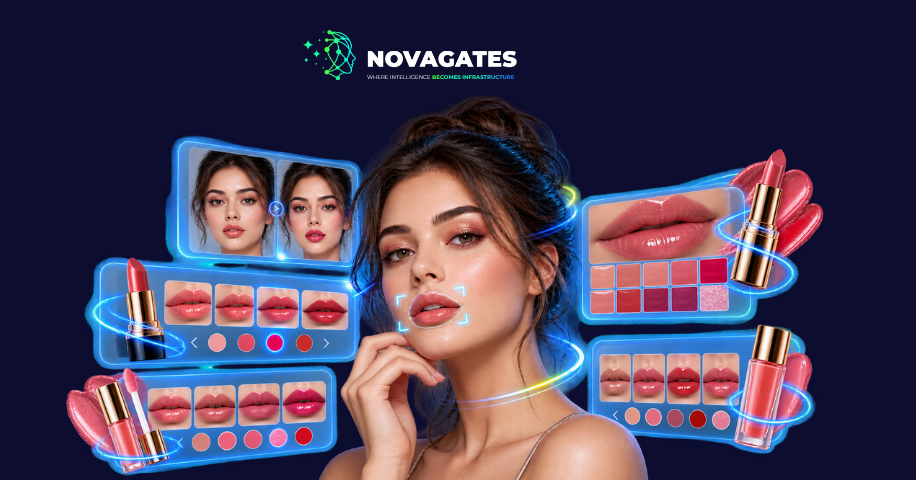
A shopper falls for a red lipstick on a model. On her screen it is a warm brick red. A week later, in her hand, it is a cool cherry that fights with her skin tone, and the lipstick goes into a drawer or back into a return box.
Lipstick is one of the hardest products to buy online, because the shade she sees is only a suggestion. Lipstick Virtual Try-On turns that suggestion into a preview on her own lips. This guide explains what it is, why choosing a shade online is so difficult, how virtual lipstick testing helps shoppers, and how beauty brands can use it to build a better lipstick shopping experience with fewer returns.
What Is a Lipstick Virtual Try-On?
Lipstick virtual try-on is a technology that uses face tracking and augmented reality to show a lipstick shade on a shopper's own lips through a phone or computer camera, in real time. The shopper sees color and finish applied to their face and can switch shades instantly, without touching a physical product.
You will see it called a virtual lipstick tester, a digital lipstick tester, online lipstick try-on, virtual lip color try-on or virtual lipstick application. Many tools also describe themselves as AI lipstick try-on, because AI is what detects and follows the lips precisely as the shopper moves. It is worth separating all of these from a lipstick shade matcher, which recommends a shade from a selfie or a few questions. A tester shows the result on the face, and the strongest experiences combine the two: a suggestion the shopper can see immediately.
In practice, three things have to work together. Face and lip tracking keeps the color exactly on the lips as the shopper talks and turns. Color and finish rendering reproduces how the shade and its finish catch light. And product data connects each shade code in your catalog to what appears on screen, so the lipstick that arrives matches the one that was tried.
Why Choosing the Right Lipstick Shade Online Is Difficult
Pigment is only part of what a shopper sees. A lipstick looks different depending on the natural color of the lips under it, the undertone of the skin around it and the light in the room. A cosmetics brand's own shade guide explains that the same cool red can read as deep crimson on one person and bright cherry on another, and that phones and monitors each render color a little differently. Careful studio photography cannot account for any of that.
Finishing adds another layer. Two lipsticks of the same color can look quite different if one is matte and the other glossy, and researchers use exactly that contrast as a test case in academic work on lipstick try-on. A static swatch rarely shows that difference.
The cost is visible in the numbers. Google research cited by the e-commerce platform Fynd found that more than 60% of online beauty shoppers have decided against a purchase because they were unsure which shade would suit them, and 41% have returned a product because the shade was wrong.
Read More: AI Makeup Technology: How It’s Transforming Beauty
How Virtual Lipstick Testing Helps Shoppers
Virtual lipstick testing gives the shopper what the screen cannot: the shade on her own lips. She opens the camera, picks a shade and sees it on her face straight away. When she turns her head, smiles or speaks, the color follows, so she judges it as it would be worn rather than as a flat swatch.
That changes the decision in four ways. She sees the shade against her own skin tone and lip color instead of a model's. She tries shades she would never have chosen from a swatch, because trying costs nothing. She compares finishes instead of imagining them. And she does all of it without touching a shared product, which removes the hygiene concern that keeps many shoppers away from testers.
It also fits how shoppers already behave. NIQ's study of 1,000 beauty consumers in Riyadh, Jeddah and Dammam found that 64% buy both online and in store, while only 3% buy exclusively online, and that whatever the channel, shoppers are trying to reduce uncertainty and build confidence. A virtual lipstick tester gives the online part of that journey what the counter gives the store part.
Comparing Lipstick Shades Before Buying
Choosing a lipstick is rarely a yes or no on a single shade. It is a comparison: this nude or that one, this red in matte or in satin, a berry for the evening or something softer for the day. A tester earns its place by making that comparison quick. These are the questions shoppers are really asking, and what the tool should let them do.
The shopper's question
What the tester should let them do
Is this shade too warm or too cool for me?
Switch between shades in one tap on the same face
Will matte look different from gloss?
See the same color in different finishes
Which of these two do I prefer?
Compare two shades quickly and save favorites
How does it look when I talk and move?
See the shade follow the lips in real time
Does it suit the way I will wear it?
Test it through their own camera, in their own lighting
The test of a good comparison experience is speed. If switching shades takes more than a tap or two, shoppers stop comparing and go back to guessing.
Lipstick Virtual Try-On for Beauty E-commerce
For an e-commerce team, the practical question is where the tester sits in the journey. These are the placements that matter most, and what to track in each.
Placement
What the shopper does
What to track
Product page
Taps 'Try it on' beside the shade swatches
Try-on rate, add-to-cart rate of testers vs non-testers
Shade selector
Tests each shade before choosing
Shade switches per session, shade-related returns
Collection page
Tries popular shades straight from the category page
Tests per session, click-through to the product
Quick add to cart
Moves from the tester to the basket
Try-on to cart conversion
Campaign or social link
Tests the featured shade from an ad or post
Sessions, completion rate, cost per tested session
In-store mirror
Tests without a shared tester
Share of tests per channel, repeat visits online
Lipstick is a natural place to start. Each purchase is a single shade decision, ranges often contain dozens of shades, and shade uncertainty is the clearest reason for returns. Start with one range, measure the result, then extend the tester to other lip products and categories.
Technically, it can be embedded through an SDK or API without rebuilding the store.Before you commit, test the tool with your own shades. Ask to see one shade rendered in matte, satin and gloss, on your own lips, in ordinary room lighting and on a phone. Academic research on lipstick try-on notes that realism and accuracy are still the hard part, particularly for finish and lighting, so a polished demo reel is not enough. Check a wide range of skin tones, the devices your customers actually use, and an Arabic right-to-left interface for the Gulf. Check also how camera consent and data are handled under rules such as Saudi Arabia's Personal Data Protection Law (PDPL).
Want to see your lipstick range in a virtual tester?
[Try Demo]
How Brands Can Create Better Lipstick Shopping Experiences
Technology alone does not create a better lipstick experience. These are the decisions that do.
Make every shade testable. A tester that covers only your bestsellers leaves the long tail, where uncertainty is highest, untouched. Map each shade's color code and finish into the tool so that what the shopper tries matches what is in the tube.
Label finish and undertone clearly. A shade name like 'Rosewood' says little. Pair each shade with its finish, undertone and a plain-language description, and let shoppers filter by them before they test.
Design the comparison. Group shades into families, make switching instant and let shoppers save favorites, so choosing becomes a short decision rather than a long hunt.
Build the look, not just the lip. Offer liner, gloss or complementary products next to the lipstick, so that a good test leads naturally to a larger basket.
Close the loop with data. Compare the most-tested shades with the most-bought shades and with returns. The gaps show which shades confuse shoppers and where your range may be missing a tone.
Then measure it.
Goal
How the tester helps
What to measure
Fewer wrong-shade returns
Shoppers see the shade on their lips before ordering
Return rate by shade, share of shade-related reasons
More confident purchases
Uncertainty drops at the moment of decision
Add-to-cart and checkout rate
Larger baskets
Shoppers build a look around the lipstick
Average order value, items per order
Better range decisions
Test data shows what shoppers explore
Most-tested shades, gaps in the shade range
The honest caveat is that the evidence on sales impact is mixed. The strongest case is the one you build yourself: run a four to six week test on one lipstick range, keep a control group, and compare tester users with non-users on conversion, returns and order value. To size the prize first, multiply your monthly lipstick orders by the share returned because of shade, and by the average cost of a return, including shipping, handling and lost product value.
Turn Shade Uncertainty Into Predictable E-Commerce Revenue With Novagates
Testing technology on your own products is the fastest way to evaluate its commercial impact on your bottom line. Novagates engineers enterprise-grade Makeup Virtual Try-On solutions designed specifically to eliminate conversion friction, lower return logistics costs, and elevate average basket sizes for global beauty brands.
By integrating our lightweight WebAR SDK into your storefront, your brand gains access to:
- High-precision, dynamic lip mapping that anchors color smoothly during motion and lighting shifts.
- True-to-life texture rendering for matte, satin, high-shine gloss, and transfer-proof liquid formulas.
- Comprehensive catalog support covering lipsticks, lip liners, glosses, and liquid stains within a single deployment.
- Strict data compliance aligned with international regulations, including Saudi Arabia’s Personal Data Protection Law (PDPL).
Quantify Your Growth Opportunity Before You Deploy
Don't evaluate virtual try-on as a speculative feature - measure it as an ROI engine. Our technical team works directly with E-Commerce Directors and Marketing Executives to model your exact ROI by analyzing your current shade-related return costs against projected conversion lifts.
Ready to eliminate buyer hesitation and transform your lipstick catalog into a high-converting digital experience?
[Try Demo]
Let Customers Try Your Lipstick Shades With Novagates
You do not have to take any of this on trust. The quickest way to judge a lipstick virtual try-on is to use one.
Novagates builds AI and AR tools for beauty and fashion brands, including virtual try-on for makeup and accessories, skin and face analysis, and an SDK for embedding the experience in your own store.
Open the free demo, allow camera access and try a lipstick shade on your own lips within seconds. While you do, look at what decides whether a tester is worth adding to your store: how realistic the color looks in ordinary lighting, how steadily it stays on your lips as you talk and turn, how quickly you can switch between shades, and how the finishes compare.
Start with the demo if you want a quick look. Choose the free trial if you want more time with the technology, or book a walkthrough if you would rather talk through your shade range with our team.
[Try Demo]
Can customers try on lipstick using a phone camera?
Yes. Lipstick virtual try-on works through a phone or computer camera, so customers do not need any special device. The technology detects and tracks the lips, so the shade appears on them in real time and moves with them. Results improve when the customer faces natural light and holds the phone at eye level.
Do lipstick shades look different on different skin tones?
Yes. A shade’s appearance depends on the natural color of the lips, the undertone of the skin and the lighting, so the same shade can look like deep crimson on one person and bright cherry on another. This is why a try-on tool should show the shade on each customer’s own face rather than on a single model, and why it should be tested across a wide range of skin tones before you adopt it.
How can beauty stores add lipstick virtual try-on to their websites?
Stores add it through a software development kit (SDK) or an application programming interface (API) embedded in the product page, so the store does not need to be rebuilt. The shades and color codes in the catalog are first connected to the tool. It is advisable to start with one category, such as lipstick, and then expand.