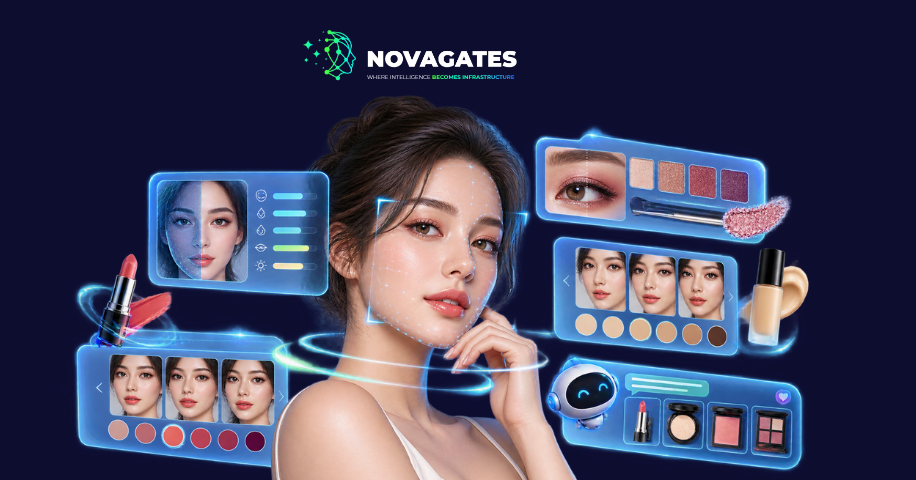
, and wA shopper loves a lipstick on a model, but she cannot tell how it will look on her. She hesitates, gets overwhelmed by shade options, and abandons the cart. For beauty brands, this uncertainty is one of the most expensive gaps in online selling, and AI makeup technology is built to close it.
This guide explains what AI makeup technology is, how it is changing the industry, how it personalizes recommendations, and what it means for your brand. At the end, you can see it running live.
What Is AI Makeup Technology?
AI makeup technology is the use of artificial intelligence, mainly computer vision, machine learning and augmented reality, to analyze a person's face and skin and then simulate or recommend makeup. A customer points a camera at themselves and sees products applied in real time, or receives shade and look recommendations matched to their own features.
Most solutions combine four capabilities:
• Face and skin analysis: detects facial landmarks, skin tone, undertone and skin conditions.
• Makeup Virtual Try-On: AR renders lipstick, foundation, eyeshadow, blush and more on the live image.
• Recommendation engines: match catalog products to the analysis and to the shopper's stated preferences.
• Conversational assistants: guide shoppers through choices in natural language.
You will see these grouped under terms such as AI in beauty, AI-powered beauty and beauty technology. In practice, AI makeup applications and AI beauty tools range from consumer apps to SDKs that a brand embeds in its own store.
How AI Is Changing the Makeup Industry
Three shifts are reshaping how makeup is discovered, tried and sold.
1. Trying a product moves from the counter to the camera. Shoppers no longer need testers and swatches to judge a shade
2. Smart features now influence purchase decisions. In GlobalData's 2025 Q4 survey of 22,613 consumers across 42 countries, 39% said the digital sophistication of a beauty product or service always or often influences their choice. The same report notes that beauty technology gained prominence at CES 2026.
3.Conversion and data become part of the business case. Shade hesitation is a leading cause of online cart abandonment. By giving shoppers instant visual proof of how a shade looks on their complexion, virtual try-on eliminates hesitation at the decision point. At the same time, every try-on session produces valuable first-party data about which shades and products customers explore.
The industry is moving from selling a product to helping the customer see the result on themselves.
How AI Helps Personalize Makeup Recommendations
1. Capture: the shopper opens the live camera or uploads a selfie, with clear consent.
2. Analyze: the AI maps facial landmarks and estimates skin tone, undertone, face shape and features.
3. Match: the analysis is compared with product attributes such as shade, finish and coverage.
4. Simulate: recommended products appear on the shopper's own face through virtual try-on.
5. Learn: the system refines future suggestions from what the shopper tries, saves and buys.
What separates a strong implementation from a weak one:
• Robustness to lighting: color looks different under a ceiling light than by a window, and good tools compensate for this.
• Inclusive tone coverage: look for evaluation against diverse skin tones, including reference scales such as the Monk Skin Tone Scale.
• Color accuracy: the single biggest reason a try-on fails to convince is that the product color looks wrong on screen.
• Honesty about confidence: the best experiences narrow the choice and let the shopper compare, rather than promising a perfect match.
No tool removes uncertainty completely, because screens and cameras vary. The goal is to make the decision easier and better informed, which is why many brands pair AI with human advisors.
Read More: AI Hair Dye Virtual Try-On | NovaTech
AI Makeup Technology for Beauty Brands
For brand and e-commerce leaders, the question is not whether the technology looks impressive. It is whether it moves the numbers that matter.
Business goal
How AI makeup technology contributes
What to measure
Higher conversion
Removes shade uncertainty at the moment of purchase
Add-to-cart and checkout rate, try-on users vs non-users
Lower cart abandonment
Eliminates shade hesitation at the moment of decision
Checkout initiation rate, cart abandonment rate by shade SKU
Larger baskets
Suggests complementary products and complete looks
Average order value, items per order
Deeper engagement
Turns browsing into interaction
Time on page, try-on sessions per visitor
Better insight
Shows which shades and looks customers explore
Most-tried products, gaps in the shade range
One experience everywhere
Runs on web, app and in-store smart mirrors
Share of sessions per channel
How to evaluate a solution
• Does it render realistic color and finish, and does it hold up in typical home lighting?
• Has it been tested across a wide range of skin tones?
• Does it run on the devices and browsers your customers actually use?
• Can your team integrate it through an SDK or API without rebuilding your store?
• How does it handle camera data, consent and privacy?
• Does it give you analytics, not only a front-end feature?
Start with a controlled test. Pick a category with high shade complexity, such as complexion products, run the experience on a subset of SKUs, and compare against a control group for four to six weeks.
Decisions made on your own data are easier to defend than industry averages.
Want to see how this would look in your catalog?
[Try Demo]
AI and Personalized Beauty Experiences
On the customer side, AI changes the whole journey: discover, try, decide, build a routine, and come back. Each step becomes more personal and more visual.
Trust decides whether these experiences work:
• Be transparent about camera use. Ask for consent clearly and explain what is stored and what is not.
• Respect local regulation. Check the data protection rules in each market you serve, for example the PDPL in Saudi Arabia or the GDPR in the EU.
• Keep a human option. A small qualitative study with Gen Z women in Belgium found a preference for hybrid models that combine AI precision with human expertise. The sample is small, but the point is worth designing for.
The Future of AI in the Beauty Industry
Expect the next phase to bring five developments:
1. Smarter devices and mirrors:
Smart beauty hardware is moving from trade-show concept to mainstream product.
2. Conversational assistants that do more:
one flow that analyzes skin, suggests products, shows them on the face and builds a routine.
3. Generative AI for looks and visuals:
useful for inspiration, though a rendered try-on and a generated image are not the same thing, and brands should label them accurately.
4. Omnichannel profiles:
the same analysis and preferences following the customer from web to app to store.
5. Higher expectations on privacy and inclusivity:
customers and regulators will ask harder questions about data and bias.
What brands can do now:
• Pilot one high-converting category with clear sales and add-to-cart KPIs.
• Set privacy, consent and inclusivity requirements before choosing a vendor to ensure a frictionless checkout flow.
• Prefer a platform that extends from makeup to adjacent categories, so cross-selling and routine building continuously boost your conversion rates.
See AI Makeup Technology in Action With Novagates
[Embed video here: a 60 to 90 second walkthrough of Novagates Makeup Virtual Try-On on mobile and desktop. Add a title, short description, captions and a transcript below the player.]
Novagates builds AI and AR tools for beauty and fashion brands, including Makeup Virtual Try-On and accessories try-on, skin and face analysis, and an SDK for embedding the experience in your own store.
[Try Demo]
Frequently Asked Questions
Can AI help customers choose suitable makeup products?
Yes. AI analyzes the customer's face and skin tone, matches products to shade, undertone and preferences, and shows them on the customer's own face through virtual try-on. This reduces guesswork. Accuracy still depends on lighting and camera quality, so the best tools let customers compare shades and refine their choice.
How can AI improve digital beauty experiences?
AI makes digital beauty shopping more personal and more visual. Shoppers can try products on live, receive shade and routine recommendations, and ask questions in natural language without visiting a store. For brands, it raises customer confidence and produces data about preferences and gaps in the shade range.
What is the difference between AI makeup technology and traditional beauty tools?
Traditional tools such as swatches, testers, shade charts and static quizzes rely on the shopper's own judgment and, often, a physical store. AI makeup technology analyzes the individual's face in real time, personalizes recommendations and shows the result instantly, online or in store.
Aspect
Traditional beauty tools
AI makeup technology
Personalization
Generic, based on charts and quizzes
Based on the individual's own face and skin
Where it works
Mostly in store
On any device with a camera, and in store via smart mirrors
Feedback
After purchase or after sampling
Instant, before purchase
Data for the brand
Limited
First-party insight into tried products and shade gaps
Scaling
Needs staff, testers and samples
Software that scales across the catalog
Main limitation
Cannot be tried online
Accuracy depends on lighting, camera and training datahat it means for your brand. At the end, you can see it running live.