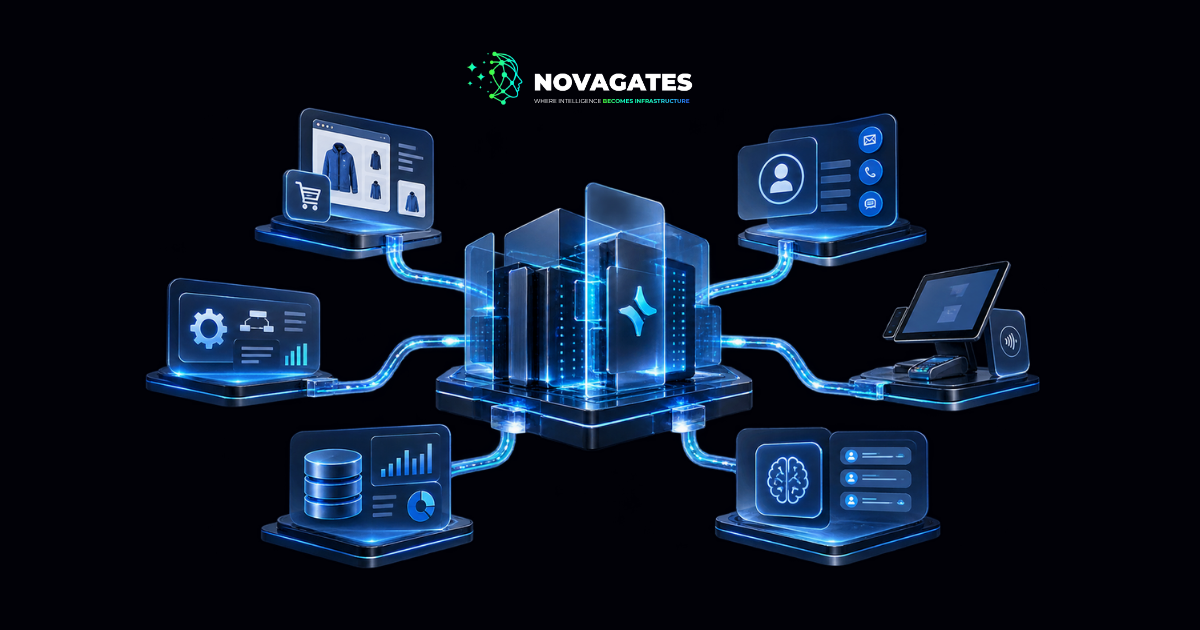
Modern enterprises rarely struggle because they lack software.
The challenge is that commerce, customer relationships, operations, payments, inventory, employees, and business data often live across separate systems.
An e-commerce platform may manage online transactions. A CRM manages customer relationships. An ERP handles business operations. A POS supports physical locations. Other platforms manage employees, marketplaces, payments, or automation.
Individually, each system may perform its role well. But as an organization grows, disconnected systems can create fragmented data, duplicated processes, operational complexity, and inconsistent customer experiences.
This is where commerce infrastructure becomes important.
Rather than treating commerce as a single online store or application, commerce infrastructure provides the connected foundation through which businesses can manage transactions, operations, customers, and the systems supporting them.
NovaCom is Novagates' commerce infrastructure layer, designed to bring these capabilities into a connected enterprise ecosystem.
What Is Commerce Infrastructure?
Commerce infrastructure is the underlying technology environment that enables a business to sell, operate, manage customers, coordinate internal processes, and connect its different commercial systems.
For a growing enterprise, commerce can involve much more than a website.
It can include:
E-commerce and digital storefronts
Product and catalog management
Customer relationship management
Enterprise resource planning
Point-of-sale operations
Human resource management
Marketplace operations
Payments and transactions
Business data and reporting
Automation and AI agents
The objective is not simply to add more software.
It is to create an environment in which the different parts of the business can work together more effectively.
Major cloud platforms are also increasingly approaching retail and commerce as connected environments spanning data, AI and customer experiences.
This distinction becomes increasingly important as organizations expand across departments, channels, markets, or countries.
Why Disconnected Business Systems Become a Problem
Imagine an enterprise where the online store, customer database, inventory system, physical locations, finance operations, and internal workflows all operate independently.
A customer might interact with one part of the company while another department has little visibility into that interaction.
Inventory information may need to move between systems.
Customer records can become fragmented.
Teams may repeatedly transfer information from one platform to another.
Management may struggle to obtain a unified view of what is happening across the organization.
Adding another application does not necessarily solve this problem. In some cases, it creates another isolated system.
The larger question becomes:
How can the organization connect commerce and business operations as one infrastructure?
That is the problem NovaCom is designed to address.
What Is NovaCom?
NovaCom is the commerce infrastructure pillar of Novagates.
It provides an ecosystem for connecting digital commerce with the operational systems businesses rely on behind it.
Instead of viewing e-commerce, CRM, ERP, POS, HRM, marketplaces, and intelligent automation as completely separate capabilities, NovaCom places them within a broader commerce infrastructure.
This allows enterprises to think beyond launching individual digital tools and toward building a connected commercial environment.
Within the wider Novagates architecture:
Novagates provides the overarching intelligence infrastructure.
NovaTech provides technology infrastructure for intelligent digital experiences, including technologies such as AI, augmented reality (AR), virtual reality (VR), Virtual Try-On (VTO), and other intelligent experience technologies.
NovaCom provides the commerce infrastructure connecting commercial and operational capabilities.
Together, these layers allow businesses to connect intelligent experiences with the systems and processes needed to support them.
What Does NovaCom Include?
NovaCom covers multiple areas of enterprise commerce and operations.
E-Commerce and Digital Commerce
Digital commerce is one part of the infrastructure.
Businesses may need storefronts, product catalogs, search capabilities, order flows, payment experiences, and the systems required to operate commerce across different channels.
For some organizations, this means a single digital storefront. For others, the requirements may involve multiple brands, markets, sellers, or business models.
The important distinction is that the storefront should not exist in isolation from the rest of the organization.
Marketplace Infrastructure
Marketplace business models introduce additional complexity.
Instead of managing only the relationship between a business and its customers, marketplaces may need to coordinate sellers, buyers, products, orders, commissions, payments, and operational processes.
Commerce infrastructure needs to support these relationships while maintaining a consistent environment for the organization operating the marketplace.
CRM and Customer Management
Customer relationships continue beyond an individual transaction.
CRM capabilities help organizations manage customer information and interactions across the customer lifecycle.
When customer management is connected to the broader commerce environment, businesses can gain a more complete understanding of how customers interact with their products, services, and channels.
ERP and Business Operations
Commerce ultimately depends on operations.
Orders, products, inventory, finance, procurement, and other business processes need systems capable of supporting the organization behind the customer-facing experience.
ERP capabilities provide an operational layer that helps enterprises coordinate these processes.
Connecting commerce with operational systems reduces the separation between what customers experience and what the organization must execute internally.
POS and Omnichannel Commerce
Commerce no longer happens exclusively online or offline.
Many businesses interact with customers across websites, applications, stores, branches, and other physical environments.
Point-of-sale infrastructure connects physical transactions with the wider commercial ecosystem.
This becomes particularly important for enterprises pursuing an omnichannel model where customers expect their interactions with the business to remain consistent regardless of channel.
This connected approach is also reflected in modern enterprise commerce platforms that bring digital and physical channels together.
HRM and Internal Operations
Commerce infrastructure also depends on the people operating the business.
Human resource management capabilities can support employee and organizational processes within the wider enterprise environment.
For larger organizations, connecting internal operations with broader business systems can help reduce fragmentation across departments.
Where Do AI Agents Fit Into Commerce Infrastructure?
Artificial intelligence is increasingly moving from answering questions to assisting with business processes.
AI agents can potentially support tasks such as customer interactions, information retrieval, workflow coordination, internal assistance, and other business activities.
But an AI agent becomes more useful when it can operate within the appropriate business context.
For example, an intelligent customer-facing system may need access to accurate product information, customer context, order information, or other authorized enterprise data to provide useful assistance.
This is why the relationship between AI and infrastructure matters.
The value is not simply in adding an AI interface. It comes from connecting intelligence to the systems and information that allow it to perform meaningful business functions.
NovaCom's inclusion of AI agents reflects this shift toward more intelligent commerce and business operations.
NovaCom vs. a Traditional E-Commerce Platform
An e-commerce platform primarily focuses on enabling online commerce.
Commerce infrastructure addresses a wider question:
What systems need to work together for the entire commercial operation to function?
For a small business, an independent storefront and several separate applications may be sufficient.
For a larger organization, however, commerce may need to connect with:
customer management → inventory → operations → payments → physical locations → employees → automation → enterprise data.
NovaCom is therefore better understood as an infrastructure approach to commerce, rather than simply another storefront.
How NovaTech and NovaCom Work Together
The relationship between NovaTech and NovaCom is central to the Novagates model.
Consider Virtual Try-On.
A customer may use a NovaTech-powered VTO experience to visualize eyewear, beauty products, fashion, accessories, or another supported product category before making a decision.
The visible experience happens at the technology layer.
But the commercial journey may continue through product information, the storefront, customer management, transactions, inventory, and other operational systems.
This creates two complementary layers:
NovaTech → intelligent experience
NovaCom → commerce and operational infrastructure
Together, they illustrate the broader Novagates concept:
intelligence should not sit separately from the infrastructure that enables the business to operate.
Who Is NovaCom Designed For?
NovaCom is relevant to organizations whose commerce and operational requirements have moved beyond isolated digital tools.
This can include enterprises operating:
E-commerce businesses
Multi-vendor marketplaces
Retail networks
Multi-location operations
B2B commerce environments
Consumer brands
Service businesses
Complex digital commerce ecosystems
The exact infrastructure required will depend on the organization's business model, existing systems, operational requirements, and growth plans.
The objective is not to deploy every available capability.
It is to build the appropriate infrastructure around how the enterprise actually operates.
From Digital Commerce to Commerce Infrastructure
The next stage of digital transformation is not necessarily about adding another platform.
For many enterprises, the greater opportunity is connection.
Connecting customer experiences with operations.
Connecting digital and physical commerce.
Connecting business systems with useful data.
Connecting AI with the infrastructure required to make it operationally relevant.
And connecting the technologies customers experience with the systems enterprises depend on behind the scenes.
That is the role of commerce infrastructure within the Novagates ecosystem.
NovaCom provides the commerce layer. NovaTech provides the intelligent technology layer. Novagates brings them together as intelligence infrastructure for modern enterprises.
Explore NovaCom
Learn more about how NovaCom approaches commerce infrastructure and connected enterprise operations through the NovaCom section of Novagates.
FAQ
What is NovaCom?
NovaCom is the commerce infrastructure pillar of Novagates. It connects capabilities across digital commerce and enterprise operations, including e-commerce, CRM, ERP, POS, HRM, marketplaces, AI agents, and related business systems.
What is commerce infrastructure?
Commerce infrastructure is the underlying technology environment that supports and connects the systems a business uses to sell, manage customers, process transactions, and operate across channels and departments.
Is NovaCom an e-commerce platform?
NovaCom includes digital commerce capabilities, but its scope extends beyond a standalone e-commerce storefront. It is designed around a broader commerce infrastructure that can connect commerce with customer management, enterprise operations, POS, HRM, AI agents, and other systems.
What is the difference between NovaTech and NovaCom?
NovaTech focuses on technology infrastructure for intelligent experiences, including AI, AR, VR and Virtual Try-On. NovaCom focuses on commerce and enterprise operational infrastructure. Both sit within the broader Novagates intelligence infrastructure ecosystem.
How do NovaTech and NovaCom work together?
NovaTech can power intelligent customer experiences while NovaCom supports the commerce and operational systems behind those experiences. Together, they can connect the customer-facing technology layer with the enterprise commerce layer.